Classical return and coherent return are different demands
A bit can return through a classical archive. Entanglement asks more of the omitted completion. At the ready cut prepare reference and subsystem in using parallel chains for . In distance formulas denotes the density operator. Keep inert and inaccessible before output formation; a joint final measurement supplies no earlier reference signal.
An -only update at the exact ready cut outputs . Its Bell probability is , independent of , giving
The Bell event supplies the lower bound. Choosing attains it by direct eigenvalues. For a qubit the distance is , rather than the binary task's . Different targets require different bounds.
A sharp readiness/completion frontier
Let each have dimension . At a causal cut, count every later available carrier other than in . is genuinely classical: the whole joint state is block diagonal in one fixed basis. has dimension . Later processing is one common unconditional CPTP map on , with fresh ancillas initially a fixed tensor-product factor of the entire cut input. No access to , other -correlated input or uncounted coherent reference memory is allowed.
Independently calibrate readiness and final Bell probability:
Readiness is a local probability, not merely a product reduced marginal.
Theorem 7.1: quantum completion across a nearly ready cut. The sharp resource-class maximum is
Sharpness includes maximally mixed reference marginal and ranges over freely chosen pre-cut instruments and post-cut decoders. It is a benchmark for the counted resources, not an attainment promise for an arbitrary source.
Proof, exact readiness. The cut factors as . In each classical branch, decomposes into pure states of Schmidt rank at most . Local Kraus operators, fresh ready ancillas and forgetting flags cannot increase that rank bound. A normalized rank- vector with Schmidt weights has
Its Bell overlap is at most ; convexity extends this to mixed outputs. This is the established Schmidt-number witness [18,48] applied across a counted causal cut.
Proof, approximate readiness. Purify the cut state to and set . If , the normalized projection has overlap with and Bell probability after the same channel. Realize the channel isometrically and the Bell test as projector . Cauchy–Schwarz on gives
With and , . Since , for ,
For larger use . Zero-probability projection and are immediate cases.
Proof of sharpness. For let and let classical label every -subset of the computational basis. Choose isometry putting the basis in inside and the rest in its orthogonal complement. Such an isometry exists because . Let be diagonal with entries on and elsewhere, and define
Each basis vector belongs to fraction of subsets, so . Applied to half of , each branch has probability , readiness and Schmidt weights on and outside it. Decode by on its image, extending trace-preservingly elsewhere. Every branch gives
Trace preservation keeps the reference maximally mixed. For larger , choose to attain one while satisfying the inequality. For , store the input in while is ready. This proves sharpness.
For a qubit with classical completion only, ,
At exact readiness this is the entanglement-breaking benchmark [11]. Readiness permits at most , not near-perfect Bell return. A simpler consequence is , hence when positive. Use confidence bounds and independent calibration margins, not only point estimates. Postselected success must charge acceptance probability; the theorem concerns unconditional outputs.
The frontier combines known Schmidt-number and purity constraints. In the qubit case its envelope also follows from singlet-fraction, negativity and marginal-purity inequalities [50,51]. The causal-cut formulation identifies their physical meaning: reliable return requires enough coherent completion, not just classical answers.
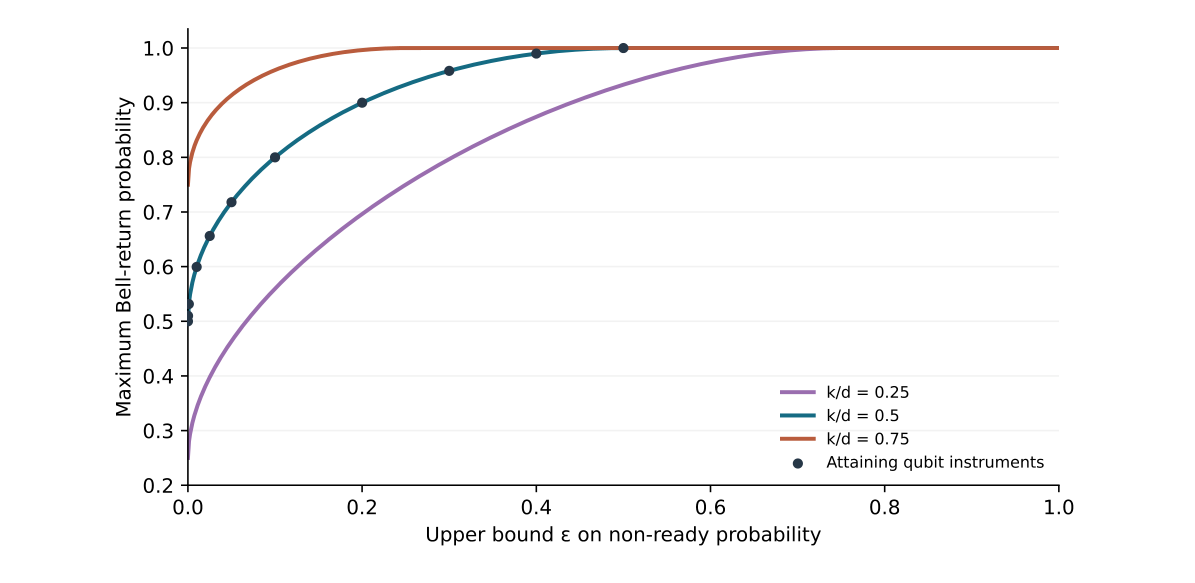
Figure 3. counts coherent dimensions outside the nominated subsystem; arbitrary classical flags are allowed. Points check explicit attaining qubit instruments. The frontier describes a resource class, not measured apparatus performance.
A reduced product state does not locate the coherent resource
Apply a uniformly chosen Pauli to half a Bell pair and retain the classical key. Omitting that key gives , with having no marginal input dependence. Reading the key and undoing the Pauli recovers the Bell pair perfectly [16]. In this operational model no separate external quantum register is needed: coherent information remains in together with its classical-key correlations.
This does not contradict no-hiding for a fully purified unitary environment. It shows why an product marginal alone cannot locate the quantum resource outside . Pure readiness, or the quantified replacement above, does essential work.
The discriminating protocol
Prepare an entangled reference input and calibrated chain. On separate identical preparations estimate midpoint readiness and test return without reference access before output. Preserve every outcome. Compare an independently bounded with (19). At ideal , the chain returns ; an endpoint-only account gives Bell probability , and a purely classical closed completion at most . Under the declared quantum operational premises, this requires coherent completion outside the ready endpoint.
Replacing the already ready endpoint at leaves the ideal global state unchanged. Replacing or decoupling the remote carrying spin can remove the return. These are different proposed interventions on the causal route, not part of the unperturbed Hamiltonian proof. Actual interventions and their calibration could locate the memory mechanism; no experimental result is claimed.
Ordinary environmental quantum memory supplies the successful completion. A full process tensor supplies the multitime laws [19]. The test excludes the declared restricted repair, not every classical mathematical ontology or operational surrogate. Its source-specific content is the common calculation of loss, timing, recovery, approximate readiness and coherent resource requirements.
Published source: Block Universe and Shadow Theory. Read the original PDF alongside the web treatment.