Local absence is not physical destruction
A source–readout claim becomes physical when the dynamics, preparation and ports are fixed before loss is assessed. An engineered perfect-transfer chain [6] provides that discipline. Its first qubit becomes exactly ready while the environment carries the input; the same Hamiltonian later returns it. This separates preservation from local possession and counts the completion resources.
The prescribed Hamiltonian
Take odd , and . Site 1 is the nominated readout ; sites form . With , let
Prepare in . Site 1 receives an unknown qubit, possibly entangled with reference . After preparation, remains fixed. There is no input-dependent controller, switching sequence or after-cut preparation-label access. Coupling calibration, ready stock, input-independent timing/phase reference, final measurement and retained output are counted. Incompatible tests use separate preparations.
This is a finite nonrelativistic quantum model. Nearest-neighbor coupling is a communication route, not an exact relativistic cone. Fabrication and calibration remain experimental obligations. Bohmian or scalar-current record constructions have different hypotheses and are not used in this channel calculation.
The vacuum is a stable ready state. For adjacent spins the exchange contribution satisfies : its one-excitation eigenvalues are , and other sectors contribute zero. Hence, with ,
Since , each displayed coefficient is positive. The vacuum is the unique zero-energy ground state. Loading the input still requires preparation resources; no finite-temperature guarantee follows.
Proposition 5.1: exact ready cut and return. At , is exactly pure-ready for every input. The input is at site up to a known phase. At it returns exactly to , preserving entanglement with an untouched reference.
Proof. Excitation number is conserved and the vacuum fixed. In the one-excitation basis , the Hamiltonian is for spin . Identify with the normalized symmetric state of auxiliary spins having up spins. Then is half the sum of their operators. Independent rotations give
Thus becomes . At only remains; at only remains, with phase . Linearity extends this to mixed and reference-entangled inputs. In particular the cut state factors as .
The factorization exceeds equality of local statistics. It also identifies an ordinary quantum completion in the environment. No exotic substrate is required. Braunstein–Pati no-hiding [2] is more general about unitary information localization; the present work supplies its timed, resource-counted instance and exact comparison.
An exact finite-horizon deficit
For binary preparations set
Use trace distance . At , a repair has only the current qubit, independent ready ancillas and one common CPTP map . It has no correlated archive or incoming carrier. With and , define
Theorem 5.2: prescribed-source finite-horizon deficit. For ,
Proof. Dephase the candidate output. This preserves the diagonal targets and contracts distance. The candidate becomes a stochastic map with excitation probabilities . Its errors are and . When , achieves zero for ; the zero case is immediate. For , an error bound implies , hence . Rearrangement gives the bound. Set to attain it by a valid measure-and-prepare channel.
At the error is , sharper than the generic half-distance bound . At it is . This is an elementary experiment-deficiency problem related to randomization and quantum sufficiency [3].
For the density-matrix coordinates are distinct, so an arbitrary numerical function on their image can invert them. Equation (8) excludes physical common CPTP postprocessing, not every mathematical forecast from exact ensemble coordinates. At the current states coincide, so a common single-valued forecast also fails uniformly across the two conditional future laws. One fixed-prior mixture can still have a correct marginal forecast. Resource insufficiency does not become universal coordinate nonclosure.
Timing and robust margins
Fix the largest coupling at . For odd ,
The out-and-back time grows linearly in chain length at bounded coupling. Holding fixed while increasing increases the strongest coupling; it does not make access arbitrarily fast.
After the ready cut put , . The endpoint amplitude, population and binary deficit are
The phase-corrected entanglement fidelity from the original input, equivalently its encoded environment at , is
The amplitude-damping Kraus operators are and ; . The known phase enters the calibrated final measurement. This channel is not a channel from the ready endpoint alone.
The classical-memory witness is crossed after
This is a witness threshold, not first arrival or first existence of quantum information. The spin model has finite-time tails. Appendix C supplies a separate exact-locality field example.
If actual binary states at differ uniformly from ideal states by at most , contractivity and two triangle inequalities yield
For with , Duhamel gives . Purification then bounds , so . Timing and readout need additional calibrated margins. These conservative sufficient bounds require independent justification, not fitting every error to the same return data.
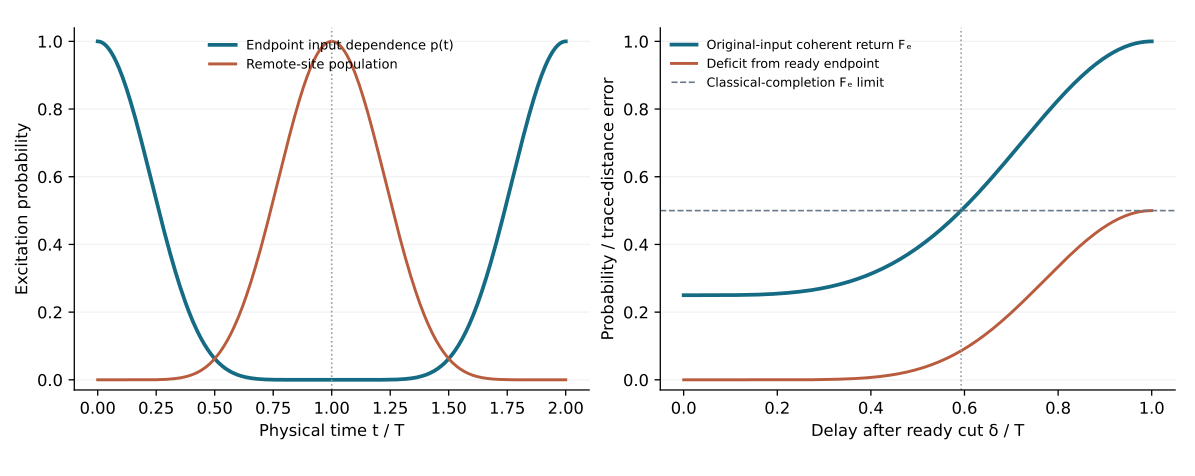
Figure 1. The prescribed five-spin source retains input globally while local population and coherent-return fidelity vary. The physical-postprocessing deficit follows from the populations. Classical-completion threshold and information location are distinct. These analytic curves were checked against matrix evolution; they are not laboratory observations.
Published source: Block Universe and Shadow Theory. Read the original PDF alongside the web treatment.